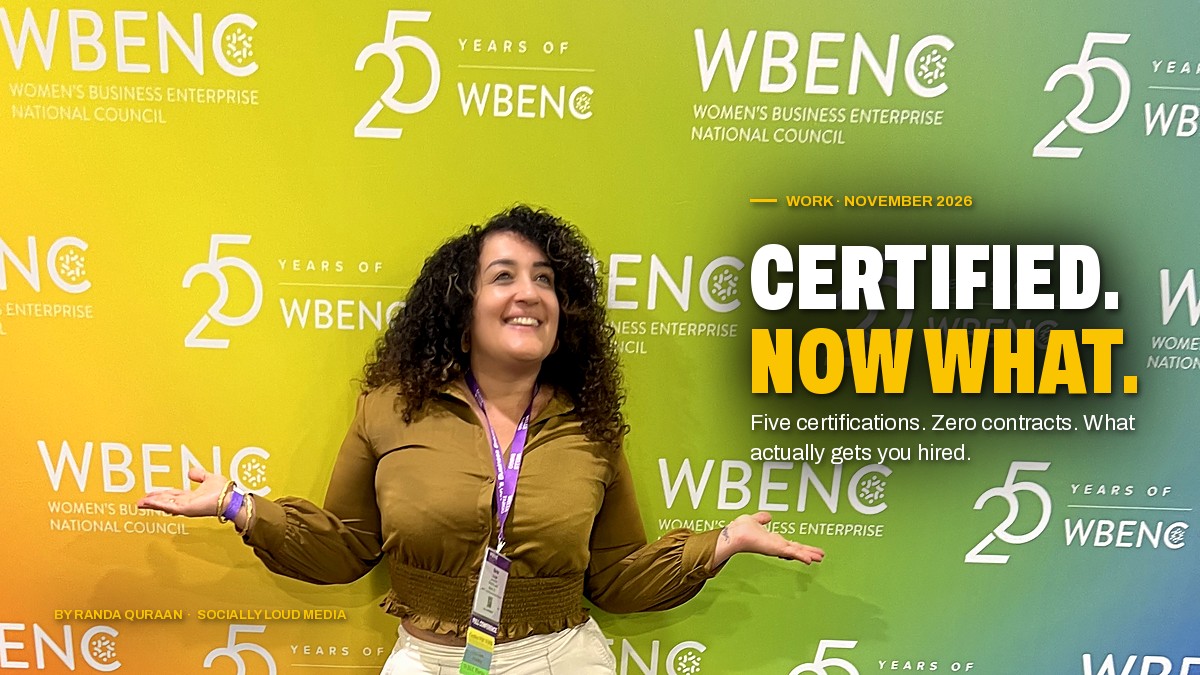
Socially Loud is certified five ways. WBENC. WOSB. Miami-Dade County SBE. Miami-Dade County Public Schools M/WBE. Broward County Public Schools M/WBE. Four of those are still active. The WBENC I let lapse this year, on purpose, after years of paying for it, flying to it, and waiting on it.
Number of contracts those certifications have produced, all five, all those years: zero.
Not a small number. Not "a few that did not pan out." Zero. Lots of conversations. Lots of business cards. Lots of "send us your capabilities deck." A few contracts promised out loud, in rooms, by people with titles. Not one signed agreement that exists because of a badge.
Before you read on, one thing. This is a story about a marketing agency. If you sell a product or a service a company actually needs and does not already have a vendor for, certification can work for you, and I will tell you why further down. I am not here to talk anyone out of it. I am here to tell the truth about what it did for a company in my space, because so many women do not say it. The ones who did it and got nothing stay quiet, because it feels ungrateful, because they are still hoping, because their photo was in the newsletter. I want the next woman to have the full picture before she writes the check.
What the badges actually are
People lump them together. They are different things run by different kinds of organizations, each with its own forms, its own renewal clock and its own directory.
WBENC is private and national. The Women's Business Enterprise National Council certifies that a company is at least 51 percent owned, controlled and run by women. You apply through a regional partner, upload formation documents, tax returns and ownership paperwork, pay a non-refundable fee, and sit for a site visit. The fee runs from $350 a year under $1 million in revenue up to $1,250 a year at $50 million and above, due again every year at recertification, with a 3 percent surcharge if you pay by card since July 2026 (WBENC). Allow about 90 days from a complete file, and the site visit repeats every three years. This is the one corporate supplier diversity teams recognize.
WOSB is federal. The Women-Owned Small Business certification comes from the SBA and it is free; WBENC bundles it into its own process at no extra charge (WBENC). It exists so federal agencies can set aside contracts for women-owned firms.
Miami-Dade County SBE is the county's Small Business Enterprise program, applied for online through the county's Business Management Workforce System and valid for three years (Miami-Dade County). It gets you into county set-asides and the county vendor directory.
Miami-Dade County Public Schools M/WBE is the school district's own program. You need 200 or fewer employees, a net worth under $5 million, 51 percent ownership by a woman or minority, and a real place of business in the county for at least a year before you apply (M-DCPS). The pitch is sheltered bids only certified firms can compete for, referrals, and a newsletter (M-DCPS Benefits of Certification).
Broward County Public Schools S/M/WBE is the same idea one county north. You register in their Ariba supplier portal, prove you have been headquartered in the tri-county area for a year with half your staff living here, and get certified for two years (Broward Schools). Review takes up to 60 days (Broward Schools RFQ).
Each school district says its certification is a "pathway" to the others. In practice, Miami-Dade Schools admits it still has no broad reciprocal agreements with Broward Schools, Palm Beach Schools or the minority supplier council (M-DCPS board item, July 2025). So you do it again. And again.
The certification fees were never the problem. Most of the local ones are free. The cost was everything around them. Five sets of documents on five different clocks. Site visits. Vendor portals that each wanted the same tax return uploaded a different way. And then the part nobody puts in the brochure: the conferences. Registration, booth fees, flights, hotels, the matchmaking add-on, the dinner you buy because that is where the procurement people are. I have spent thousands of dollars on conference fees alone over the years. That is where the real money went, and that is what I want back.
The cohort treadmill
Certification comes with an ecosystem. Once you are in the database, the invitations start. Supplier development cohorts. Capacity building programs. Accelerators for diverse suppliers. Workshops on how to do business with the county, the district, the corporation. Mentor-protégé programs. Webinars on writing a capabilities statement.
I did them. Years of them.
Here is what they teach. How to register in the vendor portal. How to format your capabilities statement. How to find the bid calendar. Elevator pitch practice. How to follow up. Then the next cohort, from a different sponsor, teaches the same thing with a different logo on the slides. The basics, over and over, to a room of women who already run companies and already know the basics, because knowing the basics was never the problem.
Nobody in those rooms teaches you the one thing you actually need, which is how to get a buyer with budget to choose you over the vendor they already have. Because the people running the cohort cannot teach that. They are not the buyer.
What the cohort costs you is time. Not a fee, usually. Time. Tuesday mornings for eight weeks. A full day downtown. The homework. The graduation. The follow-up survey. Time I was not spending on the work that a brand could actually see. Time, time, time, and nothing coming back in the other direction.
The promise
The pitch is simple. Certification gets you into supplier diversity programs. Supplier diversity programs have spend goals. Spend goals mean budget that has to go to companies like yours.
On paper, it is true. Around 85 percent of Fortune 500 companies have a supplier diversity program (Veridion). Member companies in the big councils report somewhere between 8 and 15 percent of procurement going to diverse suppliers (Burton Blatt Institute). Broward Schools writes a 29 percent M/WBE participation goal into some of its contracts (Broward Schools RFQ). On the federal side, Congress set a goal in 1994 that 5 percent of contracting dollars go to women-owned small businesses.
Here is the part they leave out of the keynote. The federal government has hit that 5 percent goal exactly twice since 1994, in fiscal 2015 and fiscal 2019 (Congressional Research Service). In fiscal 2024 it came in at 4.97 percent, and only $2.2 billion of that moved through actual women-owned set-asides. The rest was contracts anybody could have won that happened to go to a woman (Women's Procurement Council testimony). Thirty years, two passing grades.
The school district goals are real, but read the bid lists. They are construction, fire sprinkler inspection, technical staffing, food, buses. The sheltered bids are for the trades. Nobody at a school board is putting out a sheltered RFP for a brand activation.
And on the corporate side, 2025 was the year the programs started disappearing. Meta shut down its supplier diversity effort in January. McDonald's retired its supplier diversity commitments. Target renamed its supplier diversity team "supplier engagement" and ended its three-year goals. Walmart said it would re-evaluate its programs (Axios). PepsiCo told employees it would no longer have diversity goals for suppliers, Constellation Brands ended its program outright, and Harley-Davidson and Brown-Forman dropped their supplier spend goals before the year even started (USA Today). Ford dismantled its formal supplier diversity function and folded it into general procurement (SupplierDiversity.com). A few held the line. JPMorgan said it had no intention of changing its program (Reuters). Most did not.
The door the badge was supposed to open is being quietly bricked up by the people who built it.
Why it works for some businesses and not for mine
This is the part I wish someone had told me in year one.
Supplier diversity works when a company has a real need, no incumbent it is attached to, and a category where price and delivery decide the deal. Packaging. Printing. Staffing. Janitorial. IT hardware. Logistics. Uniforms. Food service. Construction and the trades. If you sell something like that, a certified company with a good price and a clean record can actually get in, because the buyer needs the thing, the thing is comparable, and the diversity badge is the tiebreaker that gets you the look. I have watched women in those categories win real contracts through these programs. Good for them. Go do it.
Marketing is the opposite in every way.
Our space is saturated. Every brand already has an agency, usually several, and a roster it is comfortable with. There is no "need" sitting open on a bid calendar waiting for a certified vendor. And when a brand does need something new, it does not go to the directory. It goes to the agencies it already uses, over and over, because the relationship is the product. The same handful of holding companies and the same handful of independents get the work, year after year, and a certified creative shop from Miami is competing against a relationship, not a price.
So the badge that is a tiebreaker in packaging is nothing in marketing. There is no tie to break. The decision was made before the RFP, if there even was an RFP.
The big agency problem
Here is how it actually goes when you are a certified creative shop and a Fortune 500 brand has a supplier diversity goal.
The brand does not hire you. The brand hires the big agency it already has. Always. The holding company that has the global contract, the retainer, the people on site. A certified agency from Miami is not going to displace that, and the supplier diversity team knows it.
So the pitch changes. "Our leverage for you is tier two. We will connect you with the agencies we contract, and they can bring you in as a diverse subcontractor." That is how the big companies hit their diverse spend numbers, by counting what their primes spend with firms like mine. The federal side works the same way; the government has met its women-owned subcontracting goal every one of the last five years while missing the prime goal almost every year (Congressional Research Service). The money is supposed to flow down through the big guys.
Number of tier two subcontracts that flowed down to us: zero.
The introductions happened. The calls happened. The big agency is polite, takes the deck, and then does the work with its own people, because why would it hand a piece of its margin to a stranger in Miami. The supplier diversity team gets to say it made the connection. The brand gets to say it has a program. And you get to update your capabilities deck for the next one.
The people who actually rooted for me
I want to be fair here, because this is the part that makes it hard to say any of this out loud.
The one real thing I got from all of it was relationships. Supplier diversity managers and procurement people who genuinely liked us, believed in the work, took my calls, remembered my name at the next conference, forwarded my deck internally, and said, in so many words, I am rooting for you. Some of them I still talk to. Some of them I would call friends.
And even with them rooting for me on the inside, nothing closed.
That tells you where the problem is. It was never the woman at the supplier diversity desk. She was doing her job and doing it well. She just does not hold the budget. The marketing director holds the budget, and the marketing director has an agency, and the marketing director has never heard of the supplier diversity program except as a line she has to report on once a year. The person who wanted to hire me could not, and the person who could hire me did not know I existed.
That is the whole game, and it took me years to see it clearly.
What actually happened to us
I did it properly. All five applications, the site visits, the renewals. The conferences, year after year, with the booth and the deck and the one-on-one matchmaking slots where you get twelve minutes with a procurement manager who has thirty of you lined up behind the curtain. The county vendor fairs. The school district "doing business with" workshops. The cohorts.
Every one of those twelve minutes ended the same way. "This is great. Send us your capabilities deck." I sent the deck. I followed up. I followed up again. The polite version of nothing came back, or nothing came back at all.
It went further than decks. I flew out, on my own dime, to meet a potential client I will not name, because the conversation had gotten serious enough that showing up in person was the right move. Good meeting. Warm room. Nothing closed. More than once over the years, someone with a title told me a contract was coming. Promised it. Named the quarter. Not one of those contracts was ever signed.
Meanwhile, this is how every client we have actually had found us.
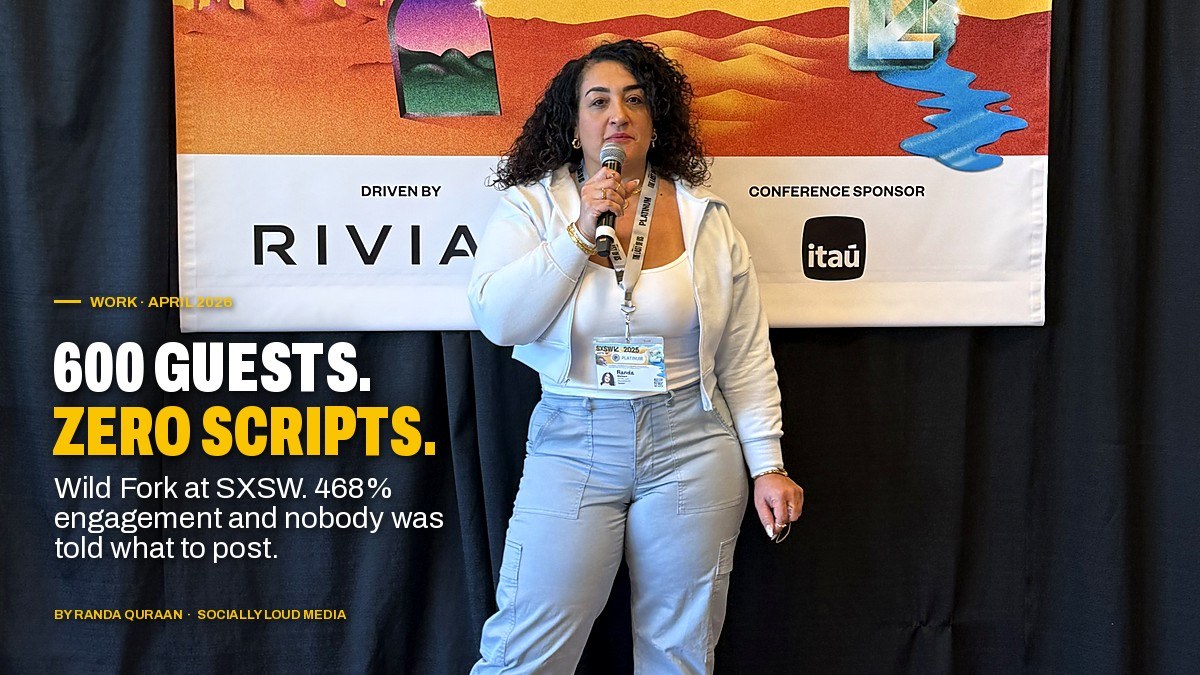
Someone was in a room we built. They sat at the PUMA x Rolling Stone dinner we ran during Art Basel at Le Chick in Wynwood, fifty creators, no posting requirement, ninety percent of them posted anyway. Someone stood in line at the Wild Fork room at SXSW and watched the brand's interactions jump 468 percent in one afternoon. Someone saw the work on a case study page, or a creator they follow tagged us, or a client we already had told a friend. Lately, someone typed "experiential agency Miami" into Google and we showed up.
Not once did a client say "we found you in the directory." Any of the five directories.
The badge never closed anything. The receipts did. Twenty years, same answer every time.
Why I let the WBENC lapse
Not anger. Math.
Every hour I spent in a matchmaking line or a cohort classroom was an hour I was not building the thing a brand could see. Every conference fee was budget that could have gone into a room with our name on it. Every renewal was a reminder that I was paying for a promise that had not paid me once. And every year the corporate programs that were supposed to need me got smaller, quieter, or renamed.
So this year, when the WBENC renewal came up, I did not send the documents. It was the one that cost money every year and the one whose whole value depended on corporate programs that are shrinking. The other four are free or close to it and sit in databases on their own clocks. I will let them run out their terms, and I am not chasing a renewal on any of them unless a buyer asks.
If a client ever makes certification a condition of onboarding, I will get it back in ninety days. That is the right order. Certification because a buyer asked for it, not certification in the hope that one will.
When it is worth it
I am not telling you never. I am telling you when.
Get certified if you sell a product or service companies actually need and buy on spec: packaging, printing, staffing, facilities, IT, logistics, uniforms, food, the trades. Those programs were built for you. The need is real, the badge gets you the look, and the look can turn into a contract.
Get certified if you sell to the federal government and you are in an industry with real set-aside volume. The WOSB is free, the set-aside is a real mechanism, and some agencies use it. Check the SBA scorecard for the agencies you want before you decide.
Get certified if you sell what school districts and counties buy through sheltered bids: construction, maintenance, staffing, IT, transportation, food. The participation goals are written into the contracts.
Get certified if a specific client you already have, or are already closing, says it is required to put you in their vendor system. Then it is not a gamble. It is paperwork for a deal that exists.
Think hard before you spend on it if you are a creative, experiential or marketing shop hoping the badge will do the selling. In our space it will not. The buyer is a brand marketing director, not a procurement officer, she already has an agency, and she hires from what she has seen. If the only path offered is "we will introduce you to our agencies," understand that you are being handed to the people with the least reason to share.
Skip the cohort unless it puts you in a room with someone who holds a budget. If the agenda is how to write a capabilities statement, you already know. Go build something instead.
What to do instead, if you are in my space
If you have the price of one conference and a week, here is what I would spend them on now.
Build one thing people can see. One room, one campaign, one series. Document it properly, photos and numbers. Put it on a page.
Put the receipts where buyers look. A case study page with the actual results. Your Google Business Profile with real photos. LinkedIn, where the people who sign agency contracts actually spend their time.
Get in the room as a participant, not an applicant. Conferences were worth it for us when we were producing something there or speaking there, never when we were standing in a supplier line.
Ask your clients for the introduction. Every real referral we have ever had came from someone who had already paid us.
Keep the relationships. The supplier diversity people who rooted for you are good people and good contacts. Just stop expecting the contract to come through that door, and stop organizing your year around it.
Keep the free certifications and forget about them. Let them sit in the database. If a buyer searches it, fine. Do not build a calendar around it.
The honest ending
I am a woman who founded a company in 2006 and has run it for twenty years. I am proud of that. I do not need five certificates on the wall to prove it, and it turns out the certificates were never going to prove it to a buyer either.
I know a lot of women reading this have the same story and have never said it. You can say it. Being honest about what did not work is not ingratitude. It is the only way the next woman gets a real answer instead of another workshop.
If you are a brand that has a supplier diversity goal and actually means it, I will take that meeting, and I will show you the rooms we have built. If you are a woman deciding whether to spend this quarter on paperwork or on the work, I just told you what twenty years taught me.
Build the thing they can see.